Combining ecological genetics and genomic predictions based on DNA-pool genotyping to identify sources of adaptation to climate change in maize landraces
Thesis defence
17/03/2026
14:00:00
Agustin O. Galaretto, GQE-Le Moulon
IDEEV, salle Rachel Carlson
Thesis directed by Stéphane Nicolas (research fellow, GQE-Le Moulon) and supervised by Alain Charcosset (research director, GQE-Le Moulon) and Brigitte Gouesnard (research fellow, AGAP).
Thesis summary
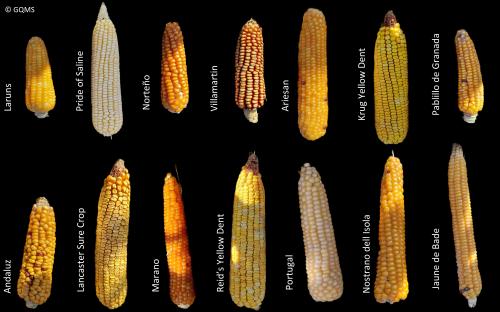
To meet future demands of food without compromising next generations, agriculture must adapt to cope with the challenges of a changing climate while reducing its environmental impact. The large maize landrace collections preserved in genebanks are a promising source of beneficial alleles for tolerance to abiotic and biotic stresses as they are highly diverse and locally adapted to a wide range of environments and human uses. However, their integration into modern breeding programs is hindered by a lack of characterization partly due to their large within-population genetic diversity.
To address this issue, I developed a strategy based on high throughput DNA-pool genotyping (HPG) to characterize and identify promising landraces and genomic regions of interest for creating new varieties adapted to future climates and low-input agriculture. To do so, I used HPG and phenotyping of 626 European maize landraces (EVA Panel) from ECPGR EVA maize and MineLandDiv projects. These landraces were selected by 9 European genebanks based on their phenotypic, climatic and molecular diversity and their patrimonial value. HPG of these landraces was performed with 50K SNP from Illumina Infinium array and 600K SNP Affymetrix Axiom arrays. EVA panel were evaluated for various agronomic traits across a field trial network of 25 environments using a sparse design.
First, I studied spatial genetic structuration of EVA panel with the 50K SNP dataset. I identified nine genetic groups consistent with their geographic origins and that differ for various agronomic traits.
To identify promising landraces, I evaluated the interest of integrating genomic offset (GO) and within-population gene diversity (Hs) in a HPG-based genomic prediction (GP) model with 50K genotyping to predict Grain Yield (GY), Male Flowering (MF) and Plant Heigth (PH) of landraces in 25 environments across Europe. I estimated GO with a gradient forest model adjusted on 50K data and climatic variables of landrace’s collection sites.
To compare predictive accuracies of GP models, I applied three cross-validation schemes to hidden observations from field experiments, corresponding to three Genebank use cases: missing observations, unknown genotype, unknown environment. GP yielded high accuracy in predicting GY, PH and MF in various environments. Adding GO and Hs in GP model (GP-GO model) increased accuracy for predicting GY (+13%) and PH (+11.8%) of unknown landraces in unknown environment. GO and Hs correlated negatively with PH and GY. GO contributed to genotype by environment interation while Hs contributed to genotypic variation. This confirmed that GO measures landrace’s mal-adaptation while Hs relates to inbreeding depression effect. GP-GO model also predicted that performance of landraces with higher Hs was more stable accross environments. This model enabled to map GY change of landraces accross Europe according to different climatic trajectories. Using this GP-GO model, I identified the future most high-performing and stable landraces in different European regions according to various climatic trajectories.
Finally, I identified 38 promising adaptive genomic regions involved in trait variation by studying colocalization of significant SNPs between (i) genome-environment association studies on 36 soil and 241 climatic variables of landrace’s collection site (ii) genome-wide association studies on 11 agronomic traits. These regions target genes involved in tolerance to abiotic stresses and could contain beneficial alleles.
This work opens an avenue for using landraces for prebreeding and for evaluating resilience of cultivated landraces to future climate.
Composition of the jury
- Yves VIGOUROUX, research director, IRD (Université de Montpellier), reviewer and examiner
- David POT, researcher, CIRAD (Université de Montpellier), reviewer and examiner
- Philippe BARRE, research engineer, INRAE (Université de Poitiers), examiner
- Mathieu GAUTIER, research director, INRAE (Université de Montpellier), examiner
- Christine DILLMAN, professor (Université Paris Saclay), examiner
Visioconference link : https://webinaire.numerique.gouv.fr/meeting/signin/invite/74812/creator/29541/hash/54286cda2af18b24d5a90cb19c8921746c305ec9