Neuroethology of taste in the honey bee Apis mellifera: from behaviour to the neural circuits
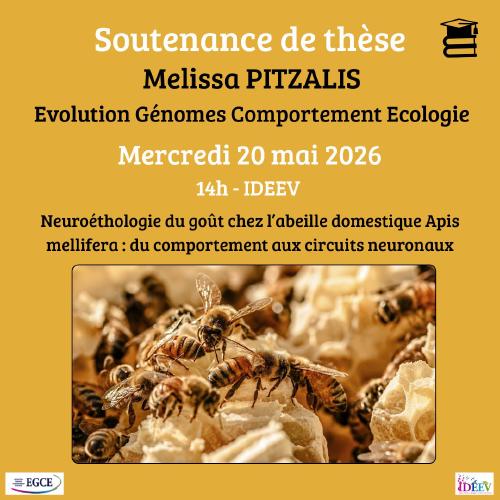
Thesis defence
20/05/2026
14:00:00
Melissa PITZALIS, EGCE
IDEEV, salle R. Franklin / R. Carson
Thesis carried out under the co-direction of Jean-Christophe Sandoz and Julie Carcaud, EGCE.
Abstract The sense of taste guides animals towards nutritious food and away from potentially harmful substances. In the case of the honey bee Apis mellifera, a social species of great ecological and economic importance, gustatory perception plays a crucial role in foraging decisions and task specialization, ultimately supporting colony performance and survival. Although the honey bee has long served as a model for research on olfaction and vision, its gustatory system remains overlooked, and important gaps persist in our understanding of the mechanisms underlying taste perception in this species. This PhD thesis aims to provide a thorough investigation of honey bee gustation by combining behavioural assays with neuroanatomical studies. Understanding which substances A. mellifera prefers or avoids is the first step towards reconstructing the process underlying its feeding choices. Using an adapted version of the multi-capillary feeder (MultiCaFe) assay, we conducted a standardized, systematic study of gustatory perception and feeding preferences in this species. Sixteen gustatory compounds of three taste qualities (i.e., salts, bitter substances, and amino acids) were tested across six concentrations. The results allowed to determine bees’ behavioural response thresholds for a wide range of tastants, and to classify them as phagostimulant, neutral, or repellent depending on concentration. Building on these findings, we investigated whether honey bees recognize tastants according to their taste quality (e.g., sweet, salty, bitter…) or their hedonic value (appetitive vs aversive), given the limited set of gustatory receptors they possess (only 11). To address this question, we developed an appetitive associative learning protocol involving both absolute and differential conditionings, in which two substances of distinct taste qualities (a bitter compound and an amino acid), but with similar mild aversiveness, were used. The results showed that bees exhibited low generalization and good discrimination abilities, suggesting that tastant recognition in honey bees relies primarily on taste quality rather than hedonic value alone. In addition, our results highlight the contribution of olfactory cues to gustatory learning, emphasizing the multimodal nature of feeding behaviours in honey bees. In parallel with the encoding of taste quality, the insect gustatory system also discriminates the spatial location of tastants. We therefore investigated the spatial organization of the neural circuits that convey gustatory information in the honey bee brain. Using anterograde mass staining with dextran-coupled fluorescent tracers applied to the main gustatory appendages (i.e., antennae, mouthparts, and foreleg tarsi), we identified the projection areas of their sensory afferents within the primary gustatory centre, the subesophageal zone (SEZ). Our results reveal that sensory inputs from different appendages are anatomically segregated within the SEZ, suggesting a somatotopic organization of gustatory circuits. Projection overlaps were more evident between inputs originating within the mouthparts, while antennal afferents likely interact with maxillary projections in the tritocerebrum and anterior SEZ. In addition, the subesophageal-calycal tract was confirmed as the principal output pathway connecting the SEZ to higher brain centres. Together, these findings advance our understanding of the behavioural and neural mechanisms underlying food evaluation and gustatory perception in A. mellifera. More broadly, this work strengthens the honey bee as a model for gustatory neuroethology, and provides a solid foundation for future investigations of gustatory coding.
Composition of the jury
- Christelle JOZET-ALVES (maîtresse de conférences, HDR, Université de Caen), reviewer and examiner
- Stephen MONTGOMERY (professor, HDR, University of Bristol), reviewer and examiner
- Ricarda SCHEINER (Full professor, Universität Würzburg), examiner
- Martin GIURFA (Professeur des universités, Sorbonne Université), examiner
- Pierre-Yves MUSSO (Chargé de recherche, Université Bourgogne Europe), examiner
Visioconference link : https://universite-paris-saclay-fr.zoom.us/j/91664069376?pwd=oRjbW3BPO0YQSQI9OgGGAAc9XmnqIq.1