Bridging the micro–macro gap in speciation research: identifying microevolutionary processes that explain differences in diversification between lineages
Thesis defence
25/06/2026
14:00:00
Pierre VERON, ESE
Institut de biologie de l'ENS (46 rue d'Ulm - Paris), salle Favard
This thesis was supervised by Hélène Morlon and Tatiana Giraud.
Abstract
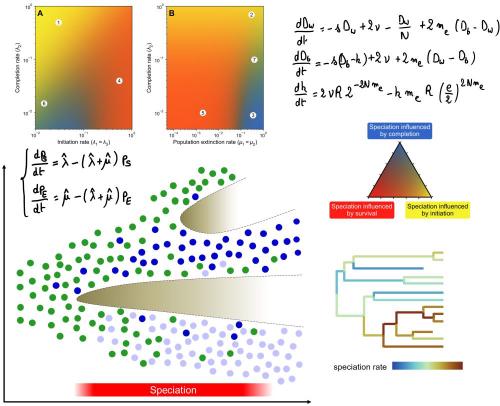
Speciation is the process by which one species gives birth to two distinct species. This process is the source of biodiversity on Earth. Phylogenetic estimates of speciation rates have revealed a high heterogeneity across lineages. Given that speciation is the large-scale consequence of microevolutionary processes, we expect to explain the variation in speciation rates by differences in microevolutionary mechanisms.
This thesis aims to better understand the link between between microevolutionary processes and macroevolutionary speciation rates, using mathematical models and empirical data. In the first chapter, I use a speciation model based on the prediction of the genetic divergence and polymorphism between populations under different scenarios. This model predicts the duration of speciation and and the shape of the grey zone, i.e., when at which speed between-populations compatibility drops. By varying parameters that describe species traits, evolutionary processes, and speciation scenarios, I assess how these factors shape speciation dynamics. I show that the link between population size and speciation duration depends on the speciation scenario, in particular that faster speciation between smaller populations is typical of non-ecological speciation. A positive correlation between population size and speciation duration in plants, which I demonstrate using previously inferred demographic parameters on genomic datasets, suggests that speciation occurs primarily through a non-ecological scenario, i.e., that adaptation to different environments is not the main source of reproductive isolation.
In the second chapter, I focus on the influence of the different steps of speciation on the macroevolutionary process. I derive, mathematically, “equivalent” speciation and extinction rates arising from the protracted birth–death model. I show that the speed at which two distinct lineages become new species has in general relatively little influence on the equivalent speciation rate. For parameters estimated on a family of Australian lizards, my analyses suggest that the most limiting steps in speciation are the formation of populations and their survival, rather than the speed of speciation completion.
In this thesis, I emphasise that the micro–macro link depends on the scenario and context of speciation. Using theoretical models, I highlight the biological processes and the steps of speciation that seem the most relevant to explain the observed differences in speciation dynamics and speciation rates. Applying these models to empirical data makes it possible to quantify the relative influence of these processes. My thesis contributes to our understanding of how speciation occurs and what factors influence its rate at the macroevolutionary scale.
Composition of the jury
- Violaine Llaurens (Directrice de recherche, Collège de France), rapporteur
- Rampal Etienne (Professor, University of Groningen), rapporteur
- Nicolas Bierne (Directeur de recherche, Université de Montpellier), examiner
- Guillaume Achaz (Professeur des universités, Université Paris-Cité), examiner
- Tatiana Giraud (Directrice de recherche, Université Paris-Saclay), PhD supervisor
- Hélène Morlon (Directrice de recherche, École normale supérieure PSL), PhD supervisor