Bridging the micro macro gap in speciation research: identifying microevolutionary processes that explain differences in diversification between lineages
SemIDEEV
18/09/2026
12:00:00
Pierre VERON - IBENS
IDEEV - Salle Rosalind Franklin
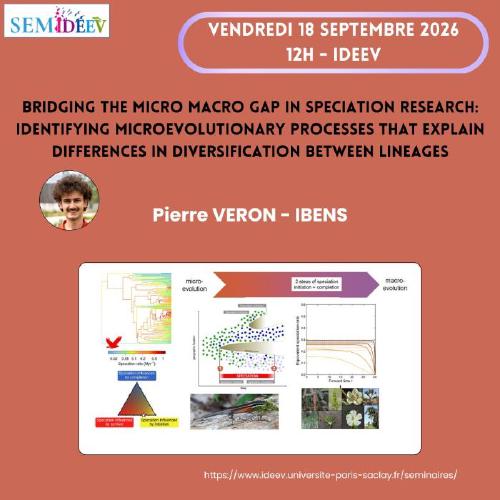
Phylogenetic estimates of speciation rates have revealed a high heterogeneity across lineages and we expect to explain the variation in speciation rates by differences in microevolutionary mechanisms. Here, I will talk about the link between microevolutionary processes and macroevolutionary speciation rates. In a first part, I will show the results of an analysis of a speciation model based on the prediction of the genetic divergence and polymorphism between populations under different scenarios. By varying parameters that describe species traits, evolutionary processes, and speciation scenarios, I assess how these factors shape speciation dynamics. I show that the link between population size and speciation duration depends on the speciation scenario, in particular that faster speciation between smaller populations is typical of non-ecological speciation. A positive correlation between population size and speciation duration in plants, which I demonstrate using previously inferred demographic parameters on genomic datasets, suggests that speciation occurs primarily through a non-ecological scenario, i.e., that adaptation to different environments is not the main source of reproductive isolation.
In a second part, I focus on the influence of the different steps of speciation on the macroevolutionary process. I derive, mathematically, “equivalent” speciation and extinction rates arising from the protracted birth–death model. I show that the speed at which two distinct lineages become new species has in general relatively little influence on the equivalent speciation rate. For parameters estimated on a family of Australian lizards, my analyses suggest that the most limiting steps in speciation are the formation of populations and their survival, rather than the speed of speciation completion.