Hosts on the run: the evolution of parasite avoidance
SemIDEEV
06/10/2026
12:00:00
Amanda Gibson, University of Virginia
IDEEV - Salle Rosalind Franklin
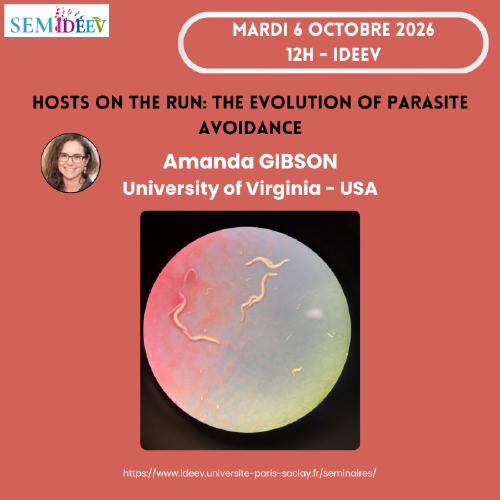
Hosts can defend themselves from infection by preventing the establishment and proliferation of the pathogens they encounter. Alternately, they can avoid contact with pathogens in the first place. The first mechanism, resistance, has garnered decades of theoretical and empirical research on its evolution, and this work demonstrates that genetic variation at resistance loci is maintained through balancing selection imposed by costs and/or genetic specificity. In contrast, we lack basic data and theory needed to understand the evolution of the second mechanism, pathogen avoidance. Avoidance represents a host’s first line of defense against pathogens, and it dictates the extent to which downstream defenses, like resistance, contribute to variation in fitness. My lab has accordingly set out to characterize the basic evolutionary parameters of this understudied defense. I will share some of our latest work testing whether avoidance evolves under similar processes as resistance, using the model nematode Caenorhabditis elegans and genomic surveys of wild-derived strains. Our initial results suggest that avoidance, and not just resistance, may contribute to the pervasive signatures of pathogen-associated diversity in host genomes.