Ecology, environmental distribution and microbial associations of Asgardarchaeota across early Earth-like ecosystems
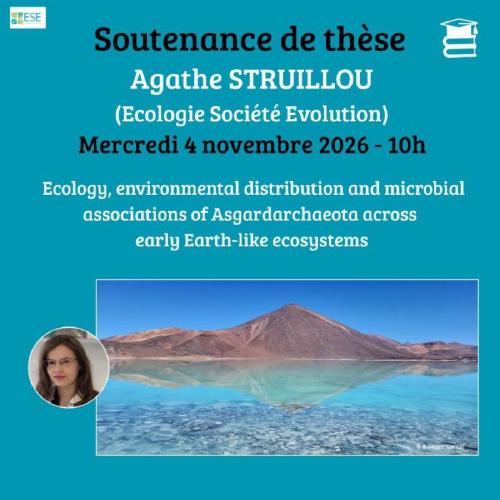
P. López-Garcia
Thesis defence
04/11/2026
10:00:00
Agathe Struillou, ESE
Salles Franklin & Carson
Thesis directed by Purificación López-García, David Moreira et Maria Ciobanu (ESE).
Abstract
Asgardarchaeota are a diverse phylum of archaea of particular interest for understanding the origin and early evolution of eukaryotic cells, owing to their close phylogenetic relationship to eukaryotes and the presence of numerous eukaryote-like molecular and cellular features. Despite their evolutionary importance, their ecological distribution, environmental preferences and associations with other microorganisms remain poorly understood, partly because most Asgard archaeal lineages are known only from environmental sequences and metagenome-assembled genomes. This thesis investigates the ecology and environmental distribution of Asgardarchaeota across contrasting ecosystems considered modern analogues of selected early-Earth environments, combining phylogenetic curation, environmental 16S rRNA gene sequencing, metagenomics and microbial co-occurrence network analyses. First, the reliability of publicly available Asgard archaeal 16S rRNA gene sequences was assessed through phylogeny-guided curation using genome-based reference frameworks. This analysis revealed substantial inconsistencies in existing database annotations and highlighted the importance of reliable reference datasets for accurately characterizing the environmental distribution of Asgardarchaeota. A curated taxonomic framework was subsequently used to investigate Asgard archaeal communities across saline and geothermal ecosystems of the Chilean Andean Altiplano and stratified microbial mats from the Danakil Depression in Ethiopia, selected for their physicochemical similarities to terrestrial environments that may have prevailed on Earth around the time of eukaryogenesis. These analyses revealed pronounced ecological differentiation among Asgard archaeal lineages, with their distributions shaped by environmental gradients including temperature, salinity and redox conditions, as well as by associations with distinct microbial communities. Co-occurrence analyses further identified fermentative recurrent microorganisms, associations with methanogenic microorganisms, and lineages associated with sulfate reduction, primarily in anaerobic contexts. Lokiarchaeia and Thorarchaeia were frequently associated with anaerobic communities, whereas Heimdallarchaeia displayed marked differentiation: Heimdallarchaeales were more abundant in the upper layers and associated with functions potentially compatible with oxygen exposure, whereas Hodarchaeales were more prevalent in deeper anoxic layers and associated with functions related to methanogenesis. Odinarchaeia, in contrast, showed a strong association with thermally influenced environments. These results support a view of Asgardarchaeota as an ecologically diverse archaeal group whose lineages occupy distinct environmental and microbial contexts rather than a single ecological niche. They also demonstrate the value of integrating phylogenetic, environmental, genomic and network-based approaches to resolve the ecology of poorly characterized microbial lineages. Finally, a microfluidic approach was initiated to investigate the spatial association of Asgardarchaeota with potential microbial partners. This approach provides a first step towards experimentally testing ecological hypotheses generated from environmental sequencing and co-occurrence analyses and could ultimately contribute to identifying close associations between Asgardarchaeota and other microorganisms in their natural environments, thereby helping to refine models of eukaryogenesis.
Composition of the jury
- Gaël Erauso — Professeur des Universités, Aix-Marseille Université
- Elisa Thebault — Chargée de recherche CNRS, Institut d’Écologie et des Sciences de l’Environnement de Paris (iEES), Sorbonne Université
- Alexis Dufresne — Chargé de recherche CNRS, Laboratoire ECOBIO (UMR 6553), Université de Rennes
- Sébastien Duperron — Professeur des Universités, Muséum national d’Histoire naturelle