New phylogenomic approaches and data to uncover the deep evolution and diversification of eukaryotes
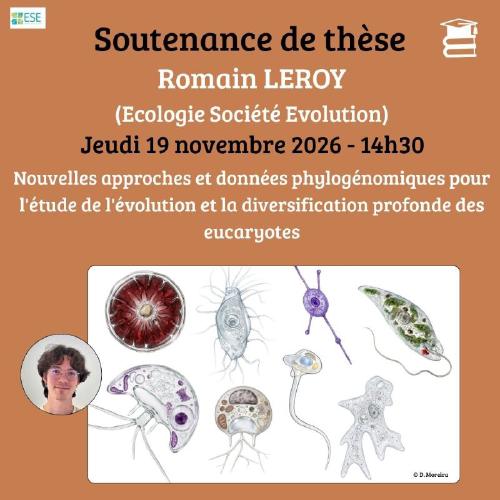
David Moreira
Thesis defence
19/11/2026
14:30:00
Romain LEROY, ESE
Institut Pascal, Bâtiment 530, rue André Rivière, 91400 Orsay
Thesis directed by David MOREIRA (direction), Purificación LÓPEZ-GARCÍA (co-direction), Laura EME (co-supervision).
Composition of the jury
- Mme Céline BROCHIER-ARMANET, Professeure des universités, Université Claude Bernard Lyon 1 – LBBE, Rapporteure
- Mme Courtney W. STAIRS, Maîtresse de conférences, Uppsala Universitet, Rapporteure
- M. Andrew J. ROGER, Professeur des universités, Dalhousie University, Examinateur
- M. Philippe LOPEZ, Professeur des universités, Sorbonne Université – ISYEB, Examinateur
- M. Iñaki RUIZ-TRILLO, Maître de conférences, Universitat Pompeu Fabra – CSIC, Examinateur
Abstract
Eukaryotes, one of three domains of Life, exhibit an astonishing diversity of shapes and sizes, life histories, behaviour and complexity. Understanding the evolutionary links among all eukaryotic lineages (i.e., reconstructing their phylogeny) remains a major challenge in modern biology. With only little to no historical attention to many deep-branching lineages, all of them unicellular eukaryotes (or protists), the definition and appreciation of eukaryotic diversity remains highly biased towards well_known multicellular phyla, notably animals, plants, and fungi, limiting our understanding of their deep diversification. The recent application of phylogenomic approaches and the characterization of an increasing number of deep-branching lineages have helped to discover that the whole eukaryotic domain can be divided into a handful of supergroup- or superphylum-level assemblages. Yet, the limited and redundant data used to reconstruct these relationships raise the question of whether these supergroups are just the product of the recurrent use of just a few hundred genes as phylogenetic markers. Finally, the study of the origin of eukaryotes through phylogenomic analyses has recently been strengthened by the discovery of the Asgard archaea, which appear to be the closest archaeal relatives to eukaryotes. However, the phylogenetic connection between eukaryotes and Asgard archaea remains controversial. In my PhD, I tackled these problems using innovative phylogenomic approaches departing from the traditional data and methods. By generating and manually curating an independent phylogenomic dataset of conserved markers for pan-eukaryotic phylogeny, my research highlighted that most previously characterized supergroups appear robust. The numerous analyses I conducted with this dataset revealed the prevalence of phylogenetic artifacts, notably long branch attraction (LBA) and compositional biases. Nevertheless, the exhaustive taxon sampling allowed to confidently place or replace several previously unstable, orphan lineages, allowing to propose an updated consensus of the eukaryotic Tree of Life. Taking advantage of this taxonomically-balanced phylogeny, I then generated a eukaryotic taxonomic framework following the methods developed by the Genome Taxonomy Database initiative for archaea and bacteria. By defining phyla and classes based on a standardized relative evolutionary divergence, this work gave clues on the pattern of early diversification of eukaryotes, which appears more similar to that of the archaeal domain than the bacterial domain. Based on the standardized relative evolutionary divergences, I reconstructed a taxonomically-balanced Tree of Life, showing the deep diversification of phyla across the three domains of Life and the prevalence of Bacteria as the most diversified domain of Life. Finally, to re-evaluate the phylogenetic relationship between eukaryotes and archaea, I used a new protein structural phylogenomics approach. I showed that structural phylogenies have important advantages compared with classical sequence-based ones, in particular they exhibit higher ultrametricity and less mutational saturation. Thus, known LBA artifacts misplacing eukaryotes in the Tree of Life can be alleviated using protein structural information. This new approach strongly supports the emergence of eukaryotes from within a specific groups of Asgard archaea, the Heimdallarchaeia. Overall, my PhD highlighted the power of using alternative methods and data to better understanding major, ancient evolutionary problems.
To attend the defence via videoconference : TBD