Chemosensory evolution at the origin of inquilinism in the bee louse fly, Braula coeca
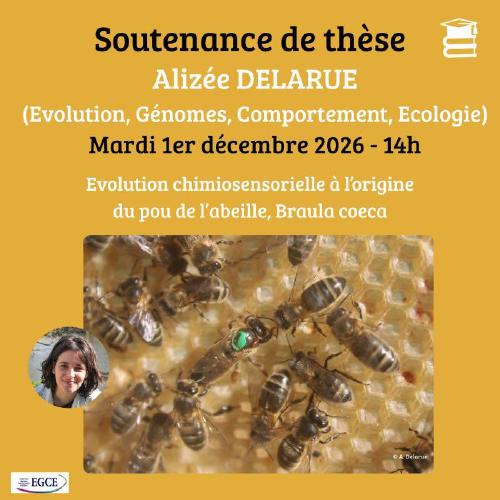
A. Delarue
Thesis defence
01/12/2026
14:00:00
Alizée Delarue, EGCE
IDEEV - Salles Franklin/Carson
Abstract
Close interspecific interactions can lead to strong specialization, as illustrated by inquilinism, in which one species exploits the habitat of another. Among the parasites of the western honey bee, Apis mellifera, Braula (Diptera: Drosophilidae) is the only obligate inquiline. The success of this blind, wingless fly may be explained by an adaptation to queen pheromones, whose anti-ovarian effects have been demonstrated in several insect species. This thesis investigates the ecological and chemosensory characteristics of Braula and their relationship with its specialized lifestyle within A. mellifera colonies. The first chapter reveals seasonal dynamics in B. coeca, the most widespread species, in a temperate island environment. Its abundance decreases in spring and increases in late summer, while its prevalence on queens rises toward the end of the season in the densest colonies, suggesting an adaptation to environmental variation. The second chapter characterizes the chemosensory abilities of B. coeca and shows that it detects a wide range of volatile compounds, with detection profiles varying according to host caste (queen or worker). However, its responses to the anti-ovarian components of queen pheromones are weaker than those of other drosophilids. Attempts to identify the corresponding ligands through heterologous expression of five candidate olfactory receptors in Drosophila melanogaster were unsuccessful. Finally, the third chapter examines the genetic diversity of Braula and identifies three species in Western Europe, two of which coexist within the same colony. The assembled genomes reveal changes in chemosensory gene families that may be associated with the evolution of behavior. Overall, this thesis shows that the association between Braula and honey bees relies on ecological and sensory specialization and proposes this association as a model for investigating the evolution of these traits in inquilines of social insects.
Composition of the jury
- Claudie DOUMS, Directrice d’étude, EPHE-PSL (Paris), Rapporteur & Examiner
- Delphine LEGRAND, Chargée de recherche, CNRS (Toulouse), Rapporteur & Examiner
- Camille MESLIN, Chargée de recherche, INRAE (Versailles), Examiner
- Nicolas GALTIER, Directeur de recherche, CNRS-ISEM, (Montpellier), Examiner
- Joël MEUNIER, Directeur de recherche, CNRS (Tours), Examiner
To attend the defence via videoconference : https://universite-paris-saclay-fr.zoom.us/j/99799456672?pwd=lX4FR69aeEVBW18KQYgpxaK6itUmUl.1 ID de réunion : 997 9945 6672 - Code secret : 924212