Genetic basis of interspecific mixing ability: identification of genomic regions and genetic trade-offs for selection
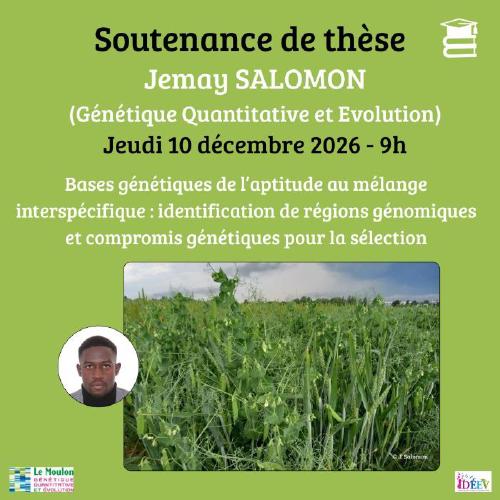
J. Salomon
Thesis defence
10/12/2026
09:00:00
Jemay Salomon, GQE
IPS2 (Amphi), 630 Rue Noetzlin Bât, 91190 Gif-sur-Yvette, France
Thesis directed by Jérôme Enjalbert (Directeur de Recherche, INRAE, GQE-Le Moulon) and co-directed by Timothée Flutre (Chargé de Recherche, INRAE, GQE-Le Moulon).
Composition of the jury
- President : Christine DILLMANN (Professeure, Université Paris-Saclay)
- Rapporteur & Examiner : Leopoldo SANCHEZ-RODRIGUEZ (Directeur de recherche, INRAE - Université d’Orléans)
- Rapporteur & Examinater : Bernadette JULIER (Directrice de recherche, INRAE - Université de Poitiers)
- Examiner : Jacques LE GOUIS (Directeur de recherche, INRAE - Université Clermont Auvergne)
- Examiner : Peter BOURKE (Assistant-professeur, Université de Wageningen)
- Invitees : Jérôme Enjalbert and Timothée Flutre
Abstract
Within-field diversification is a major lever to achieve the agroecological transition, under the rising constraints of climate change and biodiversity collapse. One timely and efficient way to practice this diversification is to sow a cereal and a legume in a mixture. In intercropping, plant-plant interactions can affect mixture yield and varietal performances, resulting in significant variety x stand type interactions. However, field trials have so far explored only limited genetic diversity, and the relative importance of the genetic (co)variances underlying change in varietal ranking between sole crops and intercrops hence remains poorly understood.
To address this gap, we first developed a genetic model, and its corresponding statistical inference model, based on direct and social breeding values (DBV, SBV), integrating a social intra-genotypic value (SIGV), which allows the joint analysis of sole crops and intercrops. Simulations were then conducted to validate the model and assess its behaviour with respect to these breeding values, in particular the SIGV. In parallel, we conducted a field trial involving 200 winter wheat varieties and 2 winter pea varieties at three sites, using a pseudo-randomized complete block design at two sites, and an incomplete, yet balanced design at the third. Grain yield was obtained per species in all sites. Other yield components: thousand kernel weight (TKW), grain protein content (GPC), grain protein yield (GPY) and several functional traits (such as phenological stages (HD), plant height (PH), specific leaf area (SLA) etc.) were also scored. Using these data, the joint model was first applied to estimate the genetic (co)variances for grain yield at each site, while accounting for species-specific and stand type patterns of spatial heterogeneity. Then, the prediction of mixture performance was tested using information from sole crops only, through both genomic and phenomic prediction. A multi-trait analysis was subsequently carried out to detect the relationship between functional traits and mixture performance. Finally, the estimates of the three types of breeding values were regressed separately on 135k SNPs through a SNP-by-SNP GWAS, and the resulting association p-values were jointly analysed by meta-analysis.
Wheat-pea intercrops yielded on average 50% more than expected from the sole crops, as indicated by a land equivalent ratio (LER) centred on 1.5. In addition, heritabilities for grain yield in sole crops and intercrops were moderate to high, from 0.5 to 0.7 (except at one site), with spatial heterogeneity revealing differences between species in intercrops. The genetic variance corresponding to the DBVs was generally the largest across traits, but SBV and SIGV variances contributed significantly in most cases, notably for grain yield and grain protein yield. The genetic correlation between DBVs and SBVs varied among traits: it was mostly positive, except for SLA and PH where it was almost null, and only weakly negative for grain yield at one site (-0.18). Using information from sole crops only, the accuracy of predicting intercrop performance was about 0.45 on average across the different methods (phenomic, genomic or phenotypic prediction), and the relative efficiency of indirect selection (RE) in sole crops varied from 0.44 to 0.53, with a notable increase when sole crops and intercrop were analysed jointly. Finally, significant SNPs were detected by GWAS for all traits, with various pleiotropic patterns revealed by meta-GWAS depending on the breeding values and traits. Overall, breeding for intercropping is both needed and feasible thanks to dedicated designs and models. More fundamentally, the new DBV-SBV-SIG model proposed in this thesis will allow a better understanding of the genetic underpinnings of how plants interact and should help breeders fine-tune their breeding programmes, depending on the proportion of resources they wish to allocate to sole crops or intercrops.