Quantifying phenotypic plasticity of biomass production and grain allocation, and leveraging high-throughput phenotyping at high spatio-temporal resolution for breeding cereal-legume intercrops : the case of wheat-pea intercropping
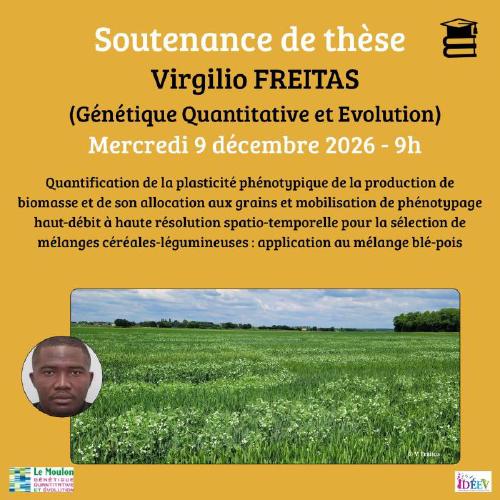
V. Freitas
Thesis defence
09/12/2026
09:00:00
Virgilio Freitas, GQE
IDEEV - Paris-Saclay University - 12 rue 128 - 91190 Gif-sur-Yvette - Salles Carson/Franklin (RDC, IDEEV)
Composition of the jury
- Mme Guénaëlle Corre-Hellou, Professeure, Institut Agro Rennes-Angers, Rapporteure
- Mme Christelle GEE, Professeure, Institut Agro Dijon, Rapporteure
- Mme Safia MEDIENE, Professeure, AgroParisTech - Université Paris-Saclay, Examinatrice
- Mme Karine ALIX, Professeure, AgroParisTech, Examinatrice
- M. Pierre CASADEBAIG, Chargé de recherche, Inrae - Université de Toulouse, Examinateur
- M. Jérôme ENJALBERT, Directeur de recherche, INRAE GQE Le Moulon, Directeur de thèse
- M. Timothée FLUTRE, Chargé de recherche, INRAE GQE Le Moulon, Co-directeur de thèse
- M. Jean-Marc GILLIOT, Maître de conférence, INRAE - ECOSYS - Agroparitech, Co-encadrant de thèse
Abstract
Conventional agriculture has increased yields at the cost of negative externalities caused by pesticides and synthetic fertilisers. Within-field diversification, such as cereal-legume intercropping, is a major lever for the agroecological transition: under low-input conditions, intercrop yield exceeds the mean of its component sole crops. This phenotypic plasticity results from plant-plant interactions, notably competition and complementarity for nitrogen through symbiotic fixation. As this plasticity has a genetic basis, breeding for intercropping requires identifying traits related to intercropping ability, together with accurate high-throughput phenotyping. This thesis aims to quantify the genetic component of plasticity in aboveground biomass production and allocation in these intercrops, notably using UAV imagery at high spatio-temporal resolution, in order to contribute to breeding. In winter wheat-pea intercropping, a low-input field trial (complete pseudo-randomised design, two years, fixed densities and crop management) evaluated 200 wheat varieties in sole crop and in mixture with two pea testers. The effort focused on a subset of 40 wheat varieties and one pea tester, with plots dedicated to destructive measurements. Phenology, morphology, physiology, growth, yield, yield components and grain quality (protein content, test weight) were measured using conventional approaches. RGB UAV flights covered the whole platform at medium altitude (tens of metres) and the subset at very low altitude (a few metres) throughout the growing cycle. As the first season was catastrophic for pea, analyses focused mainly on the second. Most intercrops used resources more efficiently than sole crops (biomass, grain, protein: gains of nearly 50%). Biomass allocation to grain was highly heritable and largely independent of stand type in wheat, although reduced in intercrop, and increased in pea. For wheat harvest index, allometric analysis showed that stand type altered the intercept but not the allometric coefficient. For most traits, genotype rankings were poorly conserved between stands, with some genotypes showing reaction norms that deviated significantly from the mean trend. Across the three stages measured (1 cm ear, heading, maturity), the genotypes with significant reaction norms differed (no significant correlation between stages). Symbiotic nitrogen fixation in pea increased in intercrop, with some wheat varieties tending to contribute more to this increase. A new multi-scale registration method for UAV images enabled very high-resolution phenotyping of plant density, the first yield component, which modulates plant–plant interactions. After regularisation, the best models combined a vegetation index, morphometry and spectral and textural descriptors, with a cross-validated prediction error below 20% in one year. At the trial scale, plant density proved highly heritable. Aboveground biomass was predicted similarly from vegetation indices and canopy height (photogrammetry), with an error below 20% at the 1 cm ear and heading stages. These methods were also used to correct for strong spatial heterogeneity prior to genetic analyses. This thesis shows that genotype × cropping system interactions are important in intercrops, but difficult to quantify precisely for each genotype, especially under strong heterogeneity. It proposes high spatio-temporal resolution phenotyping with good predictive ability for some traits. Perspectives: discriminating species in images using deep learning, and coupling UAV imagery with a crop model to predict the growth and yield of genotypes in unobserved intercrops.
To attend the defence via videoconference : more info later