“Neuroecology of dipterian flight - halthere mechanics and the evolutin of wing reduction”
SemIDEEV
16/10/2026
12:00:00
Anna Verbe, IRBI
IDEEV - Salle Rosalind Franklin
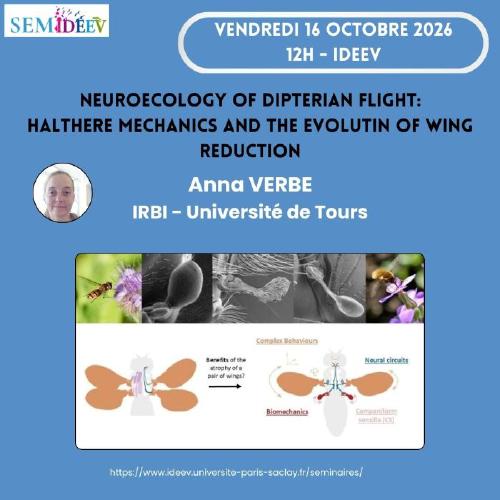
The order Diptera is found worldwide across diverse environments and includes species with varied lifestyles, with some exhibiting exceptional flight. What sets dipterans apart from other insects and is believed to underlie differences in flight, particularly in response time, is their halteres. The haltere system consists of tiny, club-shaped organs on the metathorax that evolved from the second pair of wings. While they do not serve an aerodynamic function, halteres provide essential sensory input to flight. Halteres vary among dipteran families in size, shape, and campaniform sensilla parameters. However, the evolutionary and neural logic linking haltere structure, sensory encoding, and flight behaviour across dipteran diversity remains poorly understood. Here, I present my work on the aerial righting reflex of hoverflies, the visual and mechanosensory cues stabilising flight after take-off, the campaniform activity on the Drosophila haltere, the haltere haemolymph flow using fluorescent bead tracking and CT scans to understand internal fluid dynamics and their role in haltere mechanics. This work proposes a comparative neuroecological project examining how haltere morphology, campaniform sensilla organisation, and neural circuits have diversified across dipteran families to understand the evolutionary transitions underlying halteres evolution.