Domestication and diversification of perennial fruit trees: population genomic insights from the pear genus (Pyrus L.)
Thesis defence
16/12/2025
14:00:00
Yuqi NIE, GQE-Le Moulon
ENS Paris-Saclay, amphi 1Z18
Important : new location
Thesis directed by Amandine CORNILLE and Karine ALIX.
Abstract
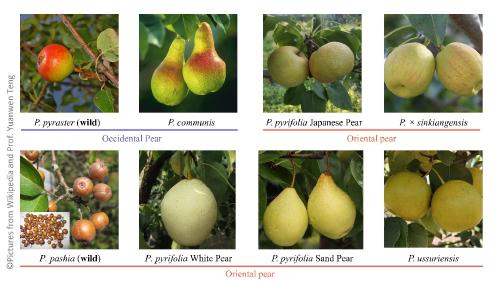
Perennial fruit trees offer unique opportunities to explore how long-lived, outcrossing species evolve and respond to human selection. Yet, their domestication histories remain far less understood than those of annual crops. This PhD thesis examines the demographic and adaptive processes that have shaped the domestication of pears (Pyrus spp.) and highlights the previously overlooked role of transposable elements (TEs) in the evolution of perennial genomes. In Chapter I, I analyze high-coverage whole-genome resequencing data from 396 wild and cultivated pear accessions representing both Occidental and Oriental lineages. Demographic modeling reveals weak or no domestication bottlenecks and extensive gene flow between wild and cultivated populations. Occidental dessert and perry pears (P. communis) arose from independent domestication events from P. pyraster, while Oriental pears (P. pyrifolia) underwent distinct domestications in China and Japan. Selection scans identify lineage- and use-specific signatures associated with fruit texture, metabolism, and immunity. Contrary to the classical “cost-of-domestication” hypothesis, cultivated pears harbor fewer deleterious variants than wild relatives, likely due to efficient purging through selection and introgression. TE insertions mirror population structure and occasionally colocalize with candidate genes under selection, suggesting a modest but measurable contribution to adaptive evolution. In Chapter II, I discuss how the biology of clonally propagated woody perennials—characterized by long lifespans, outcrossing systems, and vegetative reproduction— has shaped their genomic landscapes. We argue that TEs, long regarded as genomic parasites, act as dynamic agents of innovation in perennial crops, influencing their structural, regulatory, and adaptive evolution. Integrating TE population genomics with demographic and selection analyses provides a robust framework to understand how perennial genomes evolve under domestication and environmental pressures. Together, this work advances our understanding of perennial domestication, demonstrating that complex interactions among demography, gene flow, and TE-mediated variation shaped independent evolutionary events in pears. It underscores the need to integrate TEs into population genomic studies of long-lived crops to fully understand the mechanisms driving their adaptation and resilience to global change.
Composition of the jury
- M. Jérôme DUMINIL, IRD - Université de Montpellier, reviewer
- M. Armel SALMON, Université de Rennes, reviewer
- Mme Sophie NADOT, Université Paris-Saclay, examiner
- Mme Morgane ROTH, INRAE - Avignon Université, examiner
- M. Clément GILBERT, CNRS - Université Paris-Saclay, examiner