Contributions of the “patrimonial approach to manage the quality of living” to better in take charge biodiversity in rural territories"
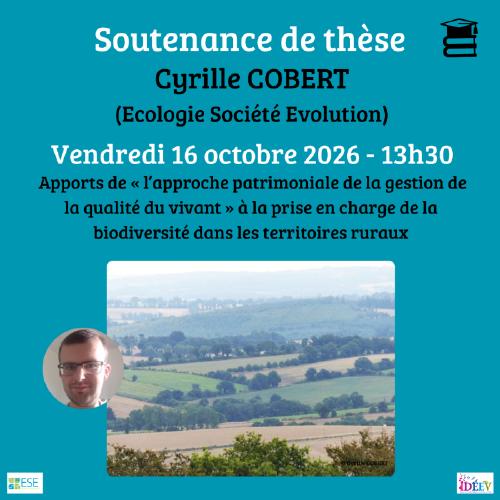
C. Cobert
Thesis defence
16/10/2026
13:30:00
Cyrille Cobert, ESE
IDEEV, salle Nicolaï Vavilov
Director and supervising members
- Mme FRASCARIA-LACOSTE Nathalie (Pr., AgroParisTech), thesis director
- Mme MAZÉ Armelle (IR HDR, INRAe), thesis director
- M. de MONTBEL Ambroise (IR, AgroParisTech), supervisor
- M. PUPIN Vincent (docteur, consultant indépendant), supervisor
Abstract
We question here the contributions of the “patrimonial approach to manage the quality of living” (Ollagnon, 1998) to address, initiate, improve taking charge of biodiversity in rural territories. Indeed, this approach proposes a theoretical framework and processes to address this complex, multi-stakeholder and transverse issue from an action perspective.
To answer our question, we led two patrimonial audits during this PhD : the first one at the national scale, the second in the community of communes Plaines et Monts de France (CCPMF), in Seine-et-Marne. We also supervised a third one in the community of communes Pays d’Evian – vallée d’Abondance (CCPEVA), in Haute-Savoie. We also studied six patrimonial audits led between 2018 and 2022, focusing on biodiversity or related topics, in six very different territories : western Anjou, maritime Flanders, Fontainebleau forest, Creuse, Occitanie, and Bauges. We wanted to understand what the stakeholders brought in terms of points of view and expertise, but also what has followed patrimonial audits in terms of taking charge of biodiversity in the territories.
Five structuring results emerge from this PhD : (i) the importance and legitimacy of the question of how taking charge biodiversity in rural territories for each audited people, question both global and territorial ; (ii) the need to link this topic with other issues in the territories – agriculture, living environment, landscapes, terroirs, rurality, etc. – that patrimonial audit allows to identify in order to mobilize stakeholders ; (iii) the extension of the concept of heterogeneity used in ecology to that of actors, actions, methods and inputs, which becomes a potential concrete asset to take globally charge of biodiversity because it multiplies the factors of mobilization and of interest in this subject ; (iv) the identification of relevant territories for action, sometimes different from the territories initially imagined for the patrimonial audit, often closer to the lived territories and, for this reason, often more mobilizing ; and (v) the importance of a long-term process, with regular discussions with stakeholders, to make possible the emergence of new and original action plans.
The case of the plain of Versailles appears then exemplary and make us confirm our results. A patrimonial process initiated in the early 2000’s on the future of periurban agriculture led to the creation, in 2004, of a heritage association which instilled an agricultural dynamism, but also defined more broadly a territorial common goal (Pupin, Viel and Colin, 2008). This association permitted to put the stakeholders in a situation where they could work together on landscapes, which resulted in the elaboration, together, of a landscape charter (Bonin, 2013). We show that a process of territorialization and common patrimonialization of the territory leads to improve taking charge of all dimensions of the territory, including biodiversity. Indeed, biodiversity is better taken into account by farmers, it constitutes an important component of the landscape charter, and the creation of a biosphere reserve is under consideration, a proposal that would never have been imagined twenty years ago.
In conclusion and perspectives, we wonder how patrimonial approach could contribute to such territorial processes in other territories. The intervention in the CCPMF’s biodiversity atlas offers important action-research perspectives that will allow us to infer or not our first results from the PhD.
Composition of the jury
- M. BÉCU Nicolas (Dr. CNRS, La Rochelle Université), rapporteur and examiner
- M. DECONCHAT Marc (Dr. INRAe, Université de Toulouse), rapporteur and examiner
- M. FOUQUERAY Timothée (MC, ENS Rennes), examiner
- Mme LE STRAT Anne (docteure, OFB), examiner
- M. MARAGE Damien (Pr., Université Marie et Louis Pasteur), examiner
- Mme NADOT Sophie (Pr., Université Paris-Saclay), examiner
Visioconference link : https://agroparistech-fr.zoom.us/j/9813275549?pwd=b1JHQW95VUs3aTVJSVF4Qml2QzBjZz09
ID de réunion: 981 327 5549 - Code secret: 699680