Patterns, vectors and mechanisms of horizontal transfer in insects
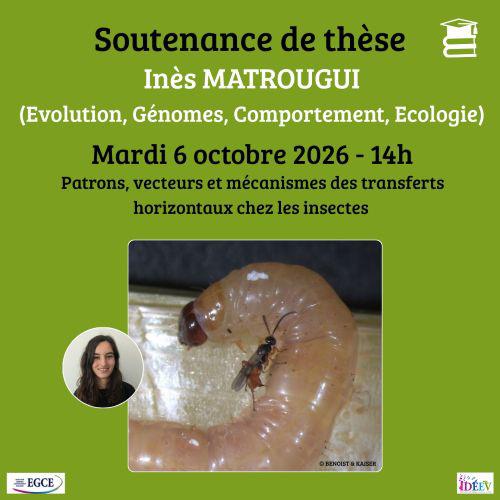
Thesis defence
06/10/2026
14:00:00
Inès Matrougui, EGCE
IDEEV, salle Carson/Franklin
Thesis directed by Clément Gilbert (EGCE) and Sylvain Charlat (PIMIT).
Abstract
Horizontal transfers are characterized by the transfer of DNA between organisms through mechanisms other than reproduction. This has long been regarded as a minor detail in eukaryotes, yet recent large-scale studies have shown that horizontal transfers are widespread, particularly in insects. However, the mechanisms enabling DNA transfer from one organism to another remain largely unexplored. One leading hypothesis suggests that viruses may act as vectors for horizontal transfer, though this role has yet to be fully evaluated. To explore this hypothesis, this thesis focused on two types of viruses: polydnaviruses (PDVs), which are domesticated viruses of parasitoid wasps, and large DNA viruses. PDVs appear to be natural agents of horizontal transfers between parasitoid wasps and their hosts. We experimentally tested whether PDVs could integrate into the host’s germline following parasitism. Despite our efforts, no germline integration was detected, suggesting that this process is extremely rare. Additionally, several aspects of the mechanisms enabling PDV integration into the host genome are still to be explored. We identified factors influencing the number of somatic PDV integrations observed in parasitized hosts: the quantity of PDVs injected into the host, the identity of the PDV circles, and the host’s susceptibility can all modulate the variation in integration number. Furthermore, we explored the idea that horizontal transfers of PDVs between wasps and their potential hosts could reveal new ecological interactions. We detected PDVs integrated into the genomes of known hosts parasitized by PDV-carrying wasps, such as Lepidoptera, Coleoptera, and sawflies (Hymenoptera). More unexpectedly, we also identified horizontal transfers in Orthoptera and Phasmatodea, which are not known to be parasitized by PDV-carrying wasps. These findings demonstrate that horizontal transfers can help identify potential new ecological interactions. Finally, we investigated the presence of transposable element transfers between different viral species of baculoviruses (large DNA viruses). Such observations could help explain why numerous horizontal transfer events involving transposable elements occur between insect species that are phylogenetically, ecologically, or geographically distant. While we were unable to formally characterize such transfers, this preliminary study provides avenues for improving our methods to better understand the role of viruses in horizontal transfers in insects.
Visioconference link : https://universite-paris-saclay-fr.zoom.us/j/92500343854?pwd=3pJduoyyGKOzSCopibJ3iE75BPYUMh.1