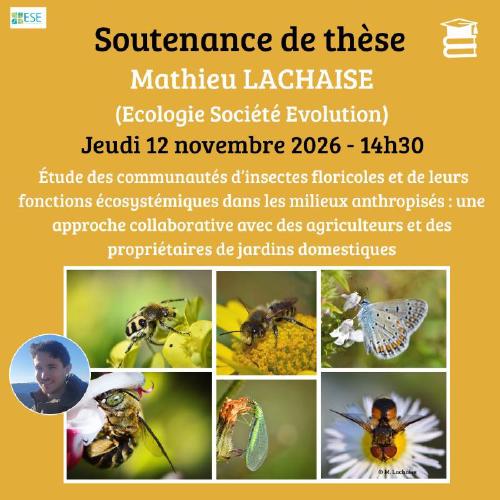
Flower-visiting insect communities and their ecosystem functions in anthropised environments: a collaborative approach with farmers and home gardeners
M. Lachaise
Thesis defence
12/11/2026
14:30:00
Mathieu Lachaise, ESE
IDEEV, rooms Franklin - Carson
Thesis directed by Emmanuelle Baudry and Blanche Collard (ESE).
Composition of the jury
- Benoît GESLIN, Maître de conférences (HDR), Université de Rennes - Rapporteur
- Nina HAUTEKÈETE, Professeure, Université de Lille - Rapporteure
- Sophie NADOT, Professeure, Université Paris-Saclay - Examiner
- Magali DESCHAMPS-COTTIN, Maître de conférences, Université Aix-Marseille - Examiner
- Bertrand SCHATZ, Directeur de recherche, CNRS, Montpellier - Examiner
Abstract
Amid ongoing agricultural intensification and urbanisation, maintaining and enhancing suitable habitats, particularly floral resources, could support flower-visiting insect communities and the ecosystem functions they provide In agricultural landscapes, I investigated floral visitor communities in blackcurrant orchards where farmers established sown and spontaneous flower strips. The results highlighted complementary benefits of these two practices for wild bees and hoverflies. In peri-urban environments, I implemented two participatory protocols with domestic garden owners. The first aimed to investigate the effects of garden characteristics (floral resources, garden size, and sun exposure) and the surrounding landscape on wild bee communities, sampled using coloured pan traps. We found a strong positive effect of pan trap sun exposure, a factor rarely considered in such studies, on the abundance and species richness of Lasioglossum bees collected. These bees comprised the majority of the individuals captured. The second protocol aimed to assess pest predation activity using predation cards deployed by garden owners. As this approach had, to our knowledge, not previously been applied in this context, the protocol also aimed to identify potential methodological limitations and assess its suitability for future research Finally, I investigated pollination function across agricultural, densely urbanised, and peri-urban landscapes, using strawberry plants of the Charlotte cultivar as a pollinometer The results did not reveal any clear effect of landscape context on pollination and raised questions about the suitability of this cultivar for investigating landscape effects on pollination.
To attend the defence via videoconference : https://visio.numerique.gouv.fr/xgd-ouuy-kpt