Selection for Robustness: When Plateaus are Slippery and Peaks are Safe
SemIDEEV
11/06/2026
13:00:00
Juliette Luiselli, KU Leuven, Belgium
IDEEV - Salle Vavilov
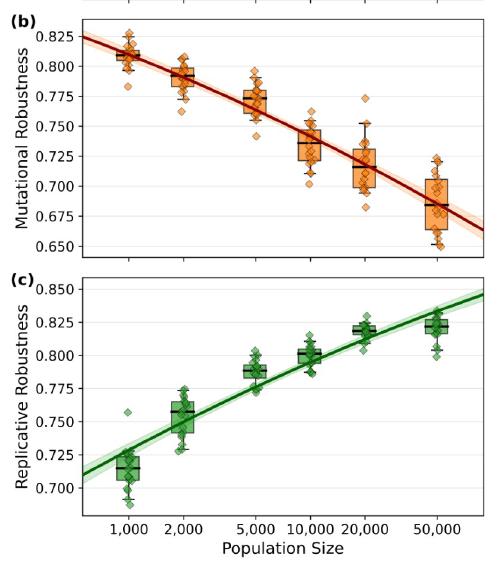
Theory predicts that populations should evolve mutational robustness — the ability to maintain a constant phenotype despite mutations. This means that populations are expected to occupy broad, flat plateaus in the fitness landscape, where most mutations are neutral, while populations on narrow peaks are more fragile (’survival of the flattest’). However, selection does not operate on single mutations but on phenotypes resulting from entire replication events, which may entail multiple mutations. We therefore distinguish mutational robustness from replicative robustness, defined as the probability that a replication event produces similarly fit offspring. Mutational and replicative robustness may seem closely aligned at first sight, but we show with an evolutionary simulation model that they can be selected in opposite directions. Our results show that while genomes with high redundancy and/or large amounts of non-coding DNA are mutationally robust, they are replicatively fragile because their size increases the number of mutations per replication. This is especially relevant when genomes are at risk of severe disruption from chromosomal rearrangements. Our results expose limits of the fitness landscape metaphor in the context of robustness evolution: neutral plateaus may be mutationally robust but replicatively unstable and therefore disfavoured by selection, whereas narrow peaks arising from densely encoded genomes can replicate more reliably. Our results identify replicative robustness as a distinct target of selection and show that whether populations persist on plateaus or peaks depends not only on tolerance to individual mutations but also on their overall likelihood of mutating.