Mechanisms Underlying Durable Disease Resistance in the Yuanyang Rice Terraces
SemIDEEV
28/08/2026
12:00:00
Huichan Huang - Yunnan Agricultural University - Chine
IDEEV - Salle Rosalind Franklin
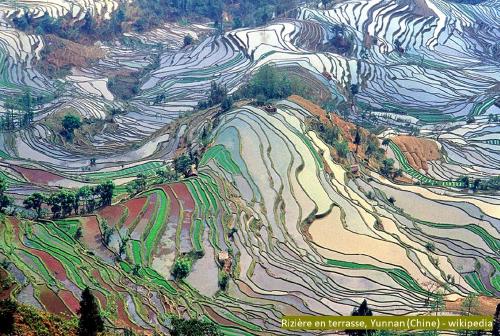
The Honghe Hani rice terraces of Yuanyang, Yunnan, are a UNESCO World Heritage site with over 1,300 years of continuous cultivation. There, more than 200 traditional rice varieties are grown in mixtures right beside the centre of diversity of the rice blast fungus (Magnaporthe oryzae), yet disease levels have remained low over the long term without any fungicide application. The talk accounts for that outcome through four mutually corroborating lines of evidence: effector–immunity interactions between the indica and japonica compartments build an immune barrier at the landscape scale; the landraces retain genetic diversity on a global scale, further enriched and maintained by balancing selection in immunity-related regions; the coexistence of five rice blast lineages constrains the risk of specialisation-driven epidemics; and farmer seed-exchange networks allow this configuration to persist over time.
Huichuan développe des recherches en épidémiologie végétale, sur la diversité inter et intra-spécifique à l’échelle de la parcelle et une diversité de sujets tels que la durabilité des résistances aux maladies chez le riz, ou l’effet du microbiote sur l’immunité des plantes : https://www.researchgate.net/profile/Huichuan-Huang En collaboration avec des collègues INRAE de PHIM (Elisabeth Fournier et Jean-Benoît Morel, projet « Riz Eternel »), il a révélé le seul exemple de gestion durable des résistances par une gestion à la ferme de la diversité variétale ( https://www.inrae.fr/actualites/diversite-plantes-accroit-durabilite-leur-resistance ).