Host factors promoting benefit from arbuscular mycorrhizal symbiosis
SemIDEEV
21/09/2026
11:00:00
Ruairidh SAWERS - Department of Plant Science, The Pennsylvania State University - USA
IDEEV - Salle Franklin
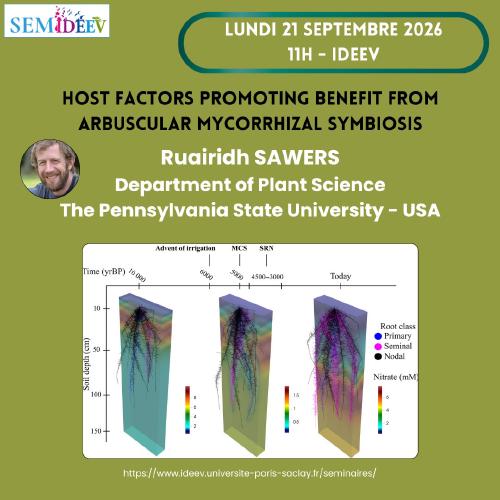
Arbuscular mycorrhizal fungi are ubiquitous in cultivated soils, forming symbiotic relationships with the roots of major crop species. Studies in controlled conditions have demonstrated the potential of the symbiosis to enhance the growth and nutrient efficiency of host plants. It is difficult, however, to estimate the benefit in the field, not least because of the lack of suitable AMF-free controls. We report the use of maize genetic mutants to generate AMF incompatible sentinel plants that serve as a baseline against which to evaluate the impact of the symbiosis. To estimate the overall effect of AMF and characterise the impact of host plant genetics on symbiotic outcome, we have selectively incorporated MF-incompatibility into maize genetic mapping populations. Using high resolution soil maps, we have shown response to AMF to vary dramatically within a single field, reflecting heterogeneity in nutrient availability. We have used QTL analysis to identify regions of the genome linked to differential performance in the presence or absence of arbuscular mycorrhizal symbiosis. In combination with allele-specific expression analysis, we are identhttps://moulon.inra.fr/en/acces/ifying candidate genes associated with different aspects of host response to AMF. The genetic architecture of host response indicates that there are trade-offs between growth with or without AMF. As such, as we pursue efforts to reduce agricultural inputs and make better use of AMF in the efficient use of soil resources, we may need to consider not only changes to management practices but also to the genetic make-up of the crops themselves.