The evolution of Drosophila color patterns: Tales of convergence, dominance and plasticity
SemIDEEV
25/09/2026
12:00:00
Artyom Kopp, University of California Davis
IDEEV - Salle Rosalind Franklin
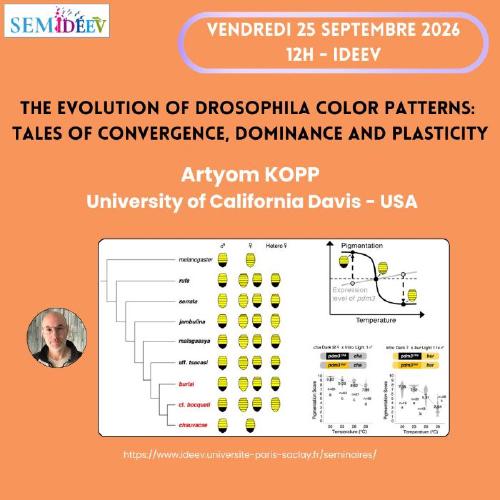
Animal pigmentation provides an unusually tractable system for asking how phenotypic diversity evolves. Across animals, similar color phenotypes can arise through either repeated use of the same genes, or through different molecular routes. I will use a striking female-limited color polymorphism in the Drosophila montium clade to explore several broader questions about the predictability and mechanisms of phenotypic evolution. Many species have independently evolved discrete light and dark female morphs, and earlier work showed that this recurrent evolution repeatedly involves the transcription factor pdm3, suggesting that some loci may represent preferred evolutionary targets. Recent comparative mapping and sequence analysis reveal a more complex history: similar polymorphisms have arisen through multiple independent mutations at pdm3, often involving distinct non-coding structural variants, while closely related species can also share color alleles through ancestral polymorphism or introgression.
I will then examine how another fundamental genetic property – dominance – evolves. Dominance relationships between pdm3 alleles differ among species, and are closely connected with environmental plasticity. Reciprocal introgressions show that these differences are caused by second-site modifiers: the same heterozygous pdm3 genotypes produce different phenotypes in different genomic backgrounds and environments. Together, these results establish the montium radiation as a model for investigating how recurrent mutation, genomic background, environmental plasticity and selection jointly shape the evolutionary trajectories of phenotypic traits.