Adapting behaviour to a changing world: from energetic constraints to individual variation
SemIDEEV
13/10/2026
12:00:00
Natacha Rossi, University of Sussex
IDEEV - Salle Rosalind Franklin
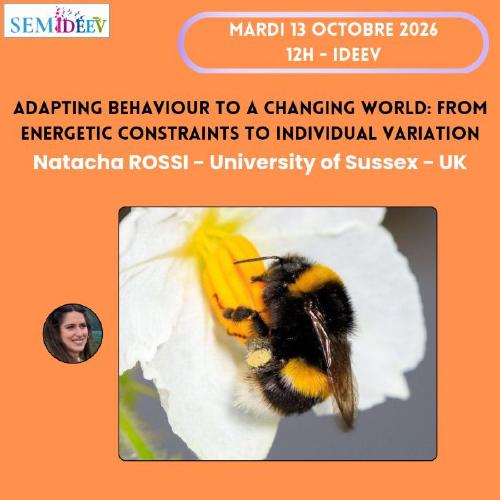
Animals face environments in which resources and physical conditions change over time. Behavioural flexibility can allow them to adjust to such changes, but these responses are shaped by both environmental conditions and the physiological constraints under which behaviour is expressed. Understanding these interactions is important for determining how animals cope with increasingly variable environments. Using bumblebees as a model system, my research examines how environmental conditions influence behaviour and its energetic costs. I will present recent work investigating how resource distribution shapes the balance between foraging and reproductive behaviour, the energetic expenditure associated with ecologically relevant behaviours, and how warming affects metabolic investment.
I will also discuss experiments showing that environmental instability can reorganise foraging behaviour while producing consequences that only become apparent after conditions have changed. Across these studies, individual variation has emerged as an important and still poorly understood component of behavioural responses. Building on these findings and observations, I will discuss how this work is leading me to ask why individuals differ in the way they adjust their behaviour when conditions change. I am developing an approach combining behavioural experiments, physiological measurements and computational modelling to determine whether such differences are consistent across contexts, identify some of the mechanisms that generate them, and test when different ways of responding to change affect performance. More broadly, this work aims to understand how physiological constraints, individual behavioural variation and environmental dynamics interact to shape animals’ responses to environmental change.